
4 Signs Your Dental Patient May Need an Oral Surgeon
General dentists often first recognize when a patient’s needs may extend beyond routine dental care. Whether you find an issue during an exam, on imaging, or while discussing long-term goals, it helps to know who to involve.
Involving an oral surgeon or a prosthodontist can create a smoother path to care. For many cases, the decision to refer is straightforward. Others are less clear.
At Facial Designs, we believe specialty care works best when it supports your relationship with your general dentist. A referral doesn’t mean handing off the patient’s overall care. It means bringing additional expertise into the treatment team when the case calls for it.
When should a patient be referred to an oral surgeon?
1. Complex Tooth Extractions & Impacted Wisdom Teeth
General dentists routinely perform extractions, but certain clinical situations may warrant referral to an oral surgeon. A referral to an oral surgeon is beneficial when they may have:
- Impacted teeth
- Impacted wisdom teeth
- Teeth with complex roots.
- Some teeth may be close to important structures.
- The case may involve multiple extractions.
- There may be major bone loss. Surgery may be needed.
- A patient’s medical history or anxiety level adds complexity to the procedure.
Early collaboration lets the oral surgeon assess the patient and plan surgery in time, before complications arise.
2. Immediate Implants or Complex Implant Cases including “Full Arch” or “Partial Arch” Rehabilitation
In a majority of cases, the implant can be placed the same day as the tooth or teeth are removed. This saves months of treatment time, and usually results in a better outcome because the anatomy in the area is preserved as opposed to requiring additional grafting to regain anatomy that is lost over months of healing with no teeth in the area.
Patients presenting with terminal dentition, advanced periodontal disease, failing restorations, or significant bone loss often require a comprehensive strategy rather than piecemeal dentistry. These cases may involve multiple implants, bone grafting, complex anatomy, or alternative implant approaches, and the surgical plan must support the intended restorative outcome from the start.
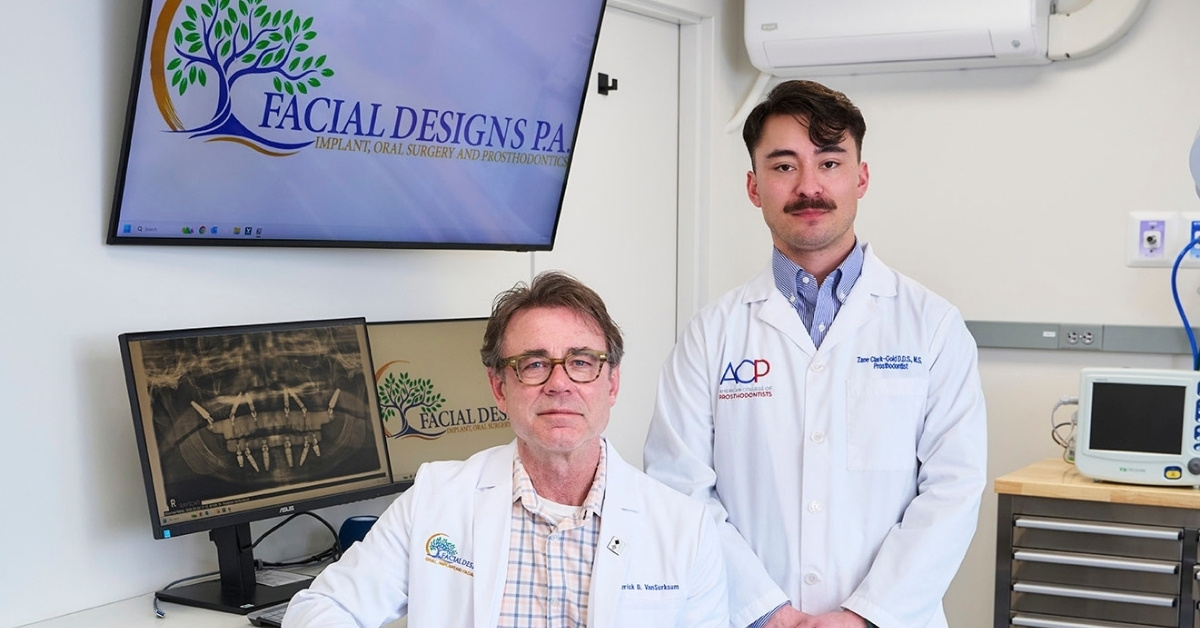
At Facial Designs, our “Rare Dr. Duo Advantage” brings Dr. Roderick VanSurksum, Board-Certified Oral & Maxillofacial Surgeon, and Dr. Zane Clark-Gold, Prosthodontist, together to evaluate complex and full-arch cases. By coordinating surgical and restorative planning under one roof, the team can consider the patient’s anatomy, implant placement, function, and final restoration as part of one cohesive plan.
This collaborative approach is particularly valuable when a patient presents with:
- Terminal dentition or multiple failing restorations that may indicate a need for comprehensive treatment rather than isolated repairs.
- Advanced periodontal disease and significant bone loss that may affect conventional implant placement.
- Multiple implant sites or complex anatomy requiring careful surgical planning.
- A history of implant complications or previous treatment challenges.
- Functional concerns that are affecting the patient’s ability to eat, speak, or maintain a comfortable smile.
- Frustration with a cycle of ongoing dental problems and a desire for a more comprehensive solution.
For patients with significant bone loss, a specialist evaluation can help determine whether additional procedures or alternative approaches may be appropriate. In cases of severe bone loss in the upper jaw, for example, evaluation may include options such as zygomatic implants.
For full-arch cases, the goal is not simply to determine where implants can be placed, but to understand how the surgical foundation will support the patient’s final teeth.
Facial Designs’ oral surgeon and prosthodontist coordinate these considerations from the beginning, while keeping the referring dentist connected to the patient’s care.
3. Pathology, Cysts or Other Unusual Findings
Sometimes a referral begins with something unexpected.
A lesion, radiographic finding, persistent swelling, unexplained discomfort, or other abnormality identified during a routine dental examination may warrant further evaluation.
When something is not part of routine dental care, or if you are not sure what you see, an oral surgeon can help.
They can assess the issue and decide if you need more tests or surgery.
You don’t necessarily need a diagnosis before making the referral. The referral reason can be that the finding needs further evaluation.
4. When Sedation or Anesthesia Adds Complexity
The procedure itself isn’t always what makes a case complicated.
Anxiety can affect how we provide care. Past trouble tolerating dental care can also affect it. The size of the planned procedure can change the approach.
Medical needs may affect care delivery. The expected length of the visit can affect how we provide care.
An oral surgery consultation lets us review these factors with the patient’s surgical needs. It helps choose the right setting and anesthesia plan. We have a Class 1 anesthesia facility right here on site at our Facial Designs Minnetonka office. We meet the same safety criteria offered in outpatient surgical centers and hospital operating rooms.
A Collaborative Care and the Post-Referral Process
Dentists don’t need to finalize an entire treatment plan before reaching out to a specialist. Early communication ensures that the general dentist, specialist, and patient have complete information before major clinical decisions are made.
A referral should never mean losing a patient.
At Facial Designs, P.A., clear communication guarantees that once high-complexity surgical or prosthetic transitions are complete, the patient returns to their general dentist for routine cleanings, exams, and essential long-term restorative support.
We serve as a collaborative resource for dentists across Minnesota, offering specialized care for wisdom teeth, complex extractions, bone grafting, zygomatic implants, and full-mouth dental implants.
Do you have a case you would like our team to evaluate? Visit our Referring Doctors page to connect with our specialists.